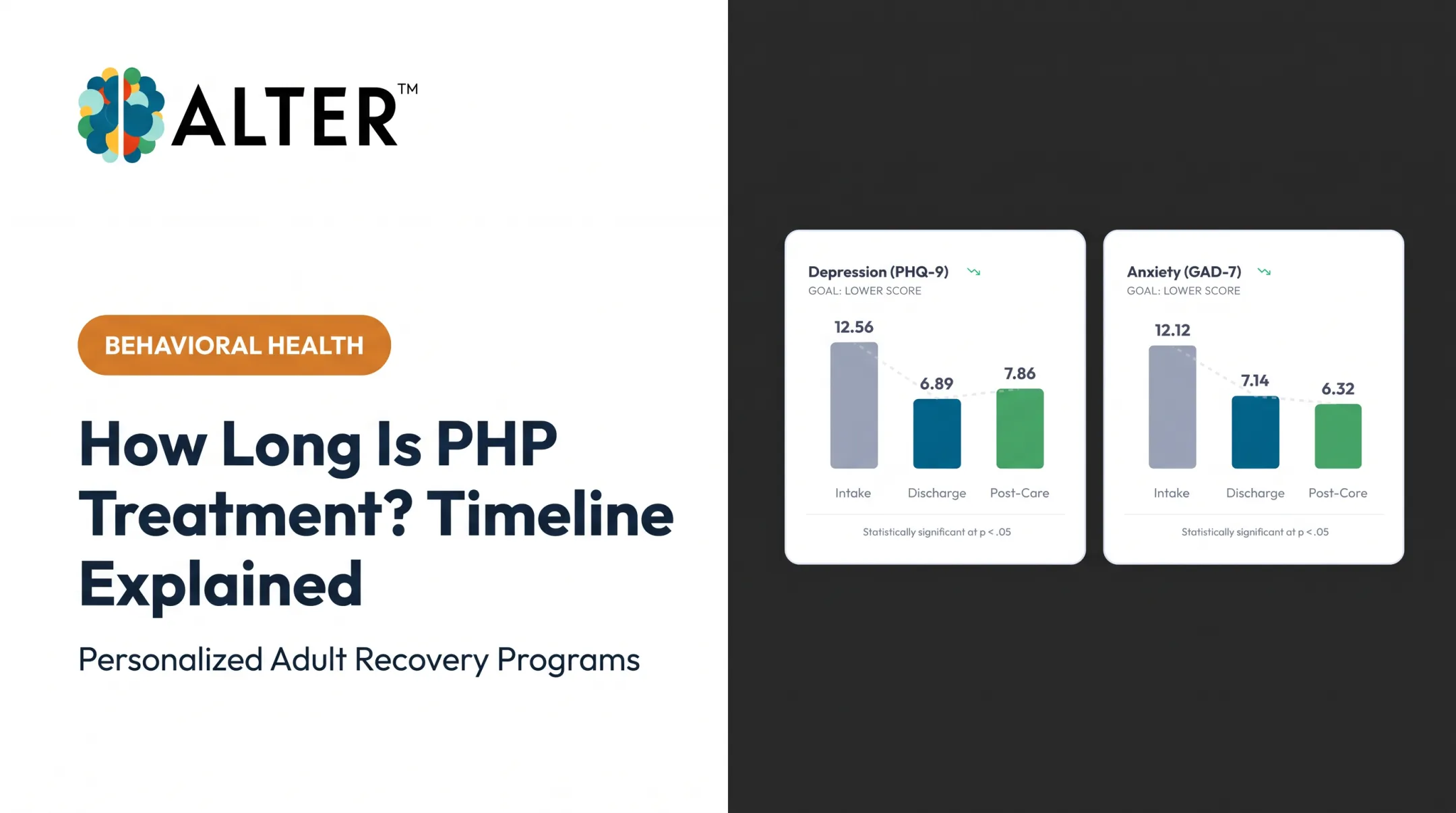

"How long" actually means two different things here. It can mean the total number of weeks you're enrolled. It can also mean how many days and hours you attend each week. Both matter, and both change as treatment moves forward. This article covers typical schedules, the factors that shape your timeline, how IOP stacks up against other levels of care, and what happens when it's time to step down.
Key Takeaways
- Treatment commonly spans several weeks to a few months; a clinician sets the endpoint, not a fixed calendar.
- Most programs meet multiple days a week for a few hours per session; exact requirements vary by provider.
- IOP offers more structure than weekly therapy while letting you live at home and keep up daily responsibilities.
- Completing IOP successfully means readiness for a lower level of care plus a clear aftercare plan.
What Is an IOP and How Long Does It Usually Last?
An intensive outpatient program is a structured level of mental health or substance use treatment that doesn't require you to sleep at the facility. You attend scheduled sessions, then go home to your own bed, your own kitchen, your own life.
That's the key difference from residential or inpatient care, where you live on-site full time. It's also more involved than standard weekly outpatient therapy, which typically means one appointment a week with far less built-in structure.
How Long Does Treatment Typically Run?
Duration varies by program and by person. According to SAMHSA's clinical guidance on intensive outpatient treatment, many courses of care extend beyond an initial four to 12 weeks, with some programs running 12 to 16 weeks before stepping down to a maintenance phase.
Alter Behavioral Health's own IOP commonly runs four to six weeks, adjusted based on each client's recovery progress and goals.
Total weeks aren't the whole picture, though. Within that window, your weekly schedule often shifts:
- Early on: More days per week, more hours per session
- Mid-treatment: Frequency may ease as stability improves
- Toward discharge: Fewer sessions, more independence between visits
What Happens During IOP Sessions
A typical program blends several service types:
- Group therapy for shared skill-building and peer support
- Individual counseling for targeted, one-on-one work
- Psychiatric evaluation and medication management when needed
- Psychoeducation and coping-skills practice
- Family sessions and discharge planning
Alter's IOP draws on evidence-based modalities including CBT, DBT, and EMDR, tailored to each person rather than applied as a fixed template. Your treatment team matches duration and intensity to your diagnosis, goals, risk level, and how you respond to care week by week.
What Determines How Long Someone Stays in IOP?
Your length of stay isn't predetermined at intake. It's reassessed continuously as your treatment unfolds.
The Initial Assessment
Before you start, clinicians look at several things together:
- Symptom severity and functional impairment
- Treatment history and prior levels of care
- Co-occurring mental health or substance use concerns
- Medical needs and safety risks
- Support systems available at home
Alter's intake process includes a psychiatric or nurse practitioner evaluation within 24 hours of arrival, alongside pre-screening questions about mental health history, substance use, and any urgent safety concerns.
How Progress Gets Measured
Clinicians track observable markers of progress. The ASAM Criteria emphasizes that movement between levels of care should follow progress and outcomes, not an arbitrary predetermined stay. In practice, that means watching:
- Attendance and active participation
- Symptom changes over time
- Ability to apply coping skills outside sessions
- Response to medication, where applicable
- Functioning at work, school, or home
What Shortens or Extends Treatment
You may step down sooner when these are in place:
- Consistent engagement and reliable attendance
- Improved emotional stability
- Dependable support at home
- Growing ability to manage responsibilities independently
The timeline often extends when these show up:
- Persistent or worsening symptoms
- Relapse or recurrence of substance use
- Trauma-related needs requiring deeper work
- Co-occurring disorders
- Limited support at home
- Difficulty translating skills into daily life
Insurance authorization and provider policies also affect the practical timeline, though clinical need should lead. Confirm coverage and authorization rules with your program before you enroll.
Progress reviews can also show that IOP is not enough on its own. If needs exceed what this level of care can safely address, a step-up to PHP, residential, inpatient, or crisis-level care may be recommended instead.
What Does the Weekly IOP Schedule Look Like?
Most programs meet several days a week for sessions lasting a few hours each. SAMHSA sets the benchmark for adult IOP at a minimum of nine clinical hours weekly. ASAM's Level 2.1 criteria describe a range of nine to 19 hours per week. Exact schedules and hours still vary by program and individual need.

Alter's IOP typically runs three hours a day, either three or five days a week. Two common track examples:
| Schedule Type | Days/Week | Session Length |
|---|---|---|
| Daytime track | 3–5 days | 3 hours per session |
| Evening track | 3–5 days | 3 hours per session, after work/school hours |
A Typical Treatment Day
A session usually includes:
- Check-in on how the week is going
- Group therapy for shared processing and skill-building
- Psychoeducation or skills practice for managing symptoms
- Individual clinical work when scheduled
- Medication or psychiatric follow-up when applicable
- A between-session plan so you can apply skills in daily life
That structure is built to fit around work, school, family care, and transportation, so many clients keep their jobs or classes going throughout treatment.
As you progress, your clinician may reduce session frequency based on attendance, symptom stability, and overall growth. Attendance still matters at every stage. If you miss a session, contact the program right away, ask how missed content is handled, and whether rescheduling is possible. Repeated absences may trigger a review of your treatment plan.
How IOP Compares With Other Levels of Care
Where IOP sits on the continuum shapes what you can expect from the schedule and the support.
| Level of Care | Time Commitment | Living Arrangement |
|---|---|---|
| Standard outpatient | One session weekly | At home |
| IOP | Several hours, multiple days weekly | At home |
| PHP | Several hours daily, most weekdays | At home or supportive setting |
| Residential/inpatient | Full-time | On-site |
Standard outpatient therapy usually means one scheduled appointment a week. That pace works well for maintenance, but it is less structured than IOP.
PHP (partial hospitalization) asks for a bigger daily commitment, often five days a week for several hours, without overnight stays. Alter's PHP commonly runs six hours a day, five days a week, offering more intensive support when IOP's lighter footprint is not enough yet.
Residential or inpatient care differs in living arrangement, supervision, and crisis response. You live at the facility, receive round-the-clock monitoring, and have immediate access to medical support if things escalate. Alter's residential programs typically run 30 to 45 days.
IOP often works as a step-down from PHP or residential care, or as a step-up from standard outpatient therapy. For people with manageable symptoms and a stable home environment, it can also be an appropriate starting point after assessment.
A common pathway looks like: Residential → PHP → IOP → Outpatient therapy.

Level-of-care decisions should always involve a licensed professional, especially where there are immediate safety concerns, severe withdrawal risk, or psychosis.
Who May Benefit From IOP — and Who May Need More Support?
IOP tends to work well for people who are:
- Medically and psychiatrically stable
- Living in a reasonably safe environment
- Able to attend sessions consistently
- Equipped with transportation or access to an approved virtual format
- Capable of practicing skills between sessions
When those conditions are in place, Alter Behavioral Health's IOP can treat depression, anxiety, trauma-related conditions, bipolar disorder, substance use concerns, and co-occurring disorders.
Signs a Higher Level of Care May Be Needed
Some situations call for more support than IOP can safely provide:
- Imminent danger to self or others
- Severe disorganization or psychosis
- Acute withdrawal risk
- Inability to stay safe at home
- Need for continuous medical monitoring
Don't try to self-select your level of care. An assessment from a qualified clinician accounts for details you might miss on your own. If you or someone you know is in immediate danger, call 911. For 24/7 crisis support, call, text, or chat the 988 Suicide & Crisis Lifeline.
How to Prepare for IOP and Plan the Next Step
A little preparation makes the first week smoother.
Before you start, gather:
- Current medication list and prescriber contact info
- Work or school communication plan for your schedule
- Transportation plan (or confirm virtual options)
- Emergency contacts
- Questions about privacy and confidentiality
Ask your provider about:
- Expected program duration and weekly hours
- Clinician qualifications and treatment modalities used
- Family involvement options
- Support for co-occurring disorders
- Insurance authorization and missed-session policies
- Discharge and aftercare planning
Alter Behavioral Health offers a full continuum: residential, partial hospitalization, intensive outpatient, transitional, and outpatient services. Care intensity can shift as your needs change, without forcing a restart with a new provider.
Personalized, evidence-based care includes aftercare planning meant to support stability after discharge. Facilities hold The Joint Commission's Gold Seal of Approval—a verified accreditation, not a guarantee of individual outcomes.
Once logistics are clear, keep momentum with a simple sequence:
- Request an assessment to confirm IOP is the right starting level
- Lock in your weekly schedule and plan around work or school
- Attend consistently and review progress with your care team
- Step down to the next level of support when you're clinically ready

Frequently Asked Questions
How long is IOP?
Most IOPs last 6 to 12 weeks. Your actual duration depends on clinical needs, progress, safety, and the program's requirements.
How many times a week is IOP?
IOP commonly meets multiple days a week for several hours per session. Confirm the exact attendance schedule with your individual program, since formats vary.
What is the daily schedule like in IOP?
A typical day includes group therapy, skills education, and any scheduled individual or psychiatric appointments, plus a plan for practicing skills between sessions. Schedules differ by provider.
What happens if you miss a day of IOP?
Contact the program promptly and ask how missed content or rescheduling is handled. Repeated absences may trigger a review of your attendance expectations or treatment plan.
Can IOP last longer than 12 weeks?
Yes. Some people need more time when symptoms, co-occurring conditions, safety considerations, or treatment goals call for extended support. The timeline is determined through ongoing clinical review, not a fixed deadline.