
Introduction
Searching for mental health treatment is stressful enough. Then you run into acronyms like PHP and IOP, and the confusion multiplies.
Both levels of care offer more structure than a weekly therapy appointment. Neither requires an overnight hospital stay. They differ in treatment hours, how closely clinicians supervise you, and how much of daily life stays intact during recovery.
The Substance Abuse and Mental Health Services Administration classifies both as outpatient care: you attend treatment and go home the same day, whether that means individual sessions, group therapy, or coping-skills training (SAMHSA, 2023).
This article breaks down what separates PHP from IOP, where each fits in the treatment continuum, and how a licensed clinician makes that call.
If you or someone you love is facing an immediate safety crisis, call 911 or go to your nearest emergency room now. Don't wait for an outpatient assessment.
Key Takeaways
- PHP delivers more daily structure and clinical oversight; IOP offers more flexibility and independence.
- Shared services often include group therapy, individual sessions, psychiatric care, and family support, though offerings vary by provider.
- The right fit depends on symptoms, safety, home environment, and a clinical assessment, not personal preference alone.
- Step-down care often moves from PHP to IOP, but that sequence isn't automatic or universal.
PHP vs IOP: Quick Comparison
Both programs sit on the same treatment continuum, but the day-to-day experience looks different. Here's how they stack up across the factors that matter most to patients and families.
| Factor | PHP | IOP |
|---|---|---|
| Weekly hours (Medicare minimum) | At least 20 hours | At least 9 hours |
| Typical schedule | Full days, most weekdays | Several hours, 3-5 days a week |
| Supervision | Closer psychiatric and clinical oversight | Structured but more independent |
| Living arrangement | Return home nightly | Return home nightly |
| Primary focus | Stabilization, intensive therapy | Skill-building, relapse prevention |
Time commitment. Medicare requires PHP to deliver at least 20 therapeutic hours per week, usually across four or more days. IOP's federal minimum is 9 hours weekly (CMS, 2024). Those are floors, not fixed schedules—programs set their own calendars.
Alter Behavioral Health, for example, runs PHP about 6 hours a day, 5 days a week, and IOP about 3 hours a day, 3 or 5 days a week. Treat those figures as one provider's model and confirm the real schedule before you enroll.
Supervision. PHP usually means closer psychiatric contact and more frequent treatment-team check-ins for people who still need intensive stabilization. IOP includes psychiatric and medical oversight too, but visits are spaced further apart so participants can function more independently between sessions.
Unlike residential or inpatient care, both PHP and IOP send participants home (or to sober living) each evening, with no overnight supervision.
Cost and insurance. PHP generally costs more per episode because it uses more treatment hours and staff time. CMS also splits reimbursement by whether a day includes three services or four-plus (CMS, 2023). Your out-of-pocket cost still hinges on your deductible, prior authorization rules, and the provider you choose.

What Are PHP and IOP?
PHP and IOP are structured outpatient programs between weekly therapy and full inpatient care. They differ mainly in intensity, weekly time commitment, and how much daytime support someone needs.
Partial Hospitalization Program (PHP)
PHP is a structured outpatient level of care for people who need substantial daytime treatment but don't require 24-hour supervision. It offers hospital-level intensity without an overnight stay.
Common components include:
- Psychiatric evaluation and medication management when clinically indicated
- Individual and group therapy using evidence-based modalities like CBT or DBT
- Psychoeducation and skills groups
- Family involvement and safety planning
Alter Behavioral Health's PHP is available at Southern California locations in Irvine, Dana Point, San Juan Capistrano, and San Diego. The program uses CBT, DBT, EMDR, and family therapy for adults managing mental health conditions, trauma, and substance use.
PHP fits situations involving significant symptom worsening, difficulty managing daily functioning, or a transition out of inpatient or residential care. It is not appropriate if someone needs continuous supervision, medical detox, or emergency psychiatric intervention. In those cases, a higher level of care comes first.
Intensive Outpatient Program (IOP)
IOP provides more structure than weekly therapy while leaving room for work, school, or family responsibilities. Sessions typically run a few hours at a time, several days a week, rather than consuming most of the day.
Typical IOP elements include:
- Group and individual therapy
- Family sessions where available
- Psychiatric or medication follow-up
- Coping-skills practice and relapse-prevention planning
Alter structures its IOP around 3-hour sessions, three or five days a week. Clients can keep working or attending school while building on skills they've already started developing.
IOP works best for people with relative stability who still need more than once-a-week support, or who are stepping down from PHP or residential treatment. It depends more on a safe home environment and reliable transportation (or virtual access, where offered), since much of the recovery work happens between sessions.
PHP vs IOP: What Is Better for Different Needs?
Neither program is "better" in the abstract. The right answer is the least intensive level that can safely and effectively meet someone's current needs, which is a clinical judgment, not a guess.
Start with safety and symptom severity. A clinician will weigh:
- Suicidal or self-harm risk
- Psychosis or mania symptoms
- Active substance use or withdrawal risk
- Medication needs
- Recent ER visits or hospitalizations
If there's acute danger, neither PHP nor IOP is the answer. That calls for immediate emergency care.
Daily functioning matters too. PHP may fit someone who can't currently maintain a stable daily routine, basic self-care, or work obligations. IOP tends to fit someone who can safely continue their job, schooling, or caregiving responsibilities while still showing up for structured treatment.
Home environment shapes the decision. A supportive, stable household can make IOP workable even for someone managing real symptoms. A stressful, unsafe, or isolated living situation often points toward PHP or a more intensive option until that environment stabilizes.
A proper clinical assessment reviews history, current symptoms, medication, support network, treatment goals, and practical factors like insurance coverage.

Alter Behavioral Health completes this evaluation during intake. Within 24 hours of admission, clients meet with a psychiatrist or nurse practitioner, and a primary therapist conducts a full assessment. That process determines clinical fit before any level-of-care recommendation.
Real-World Examples and Care-Planning Scenarios
Seeing how these decisions play out in practice can make the levels of care feel less abstract.
Scenario 1: Stepping down from inpatient care. Someone is discharged from inpatient psychiatric treatment but still needs daily structure to maintain stability. PHP offers a middle ground: intensive daytime programming, psychiatric follow-up, and group therapy, while the person returns to a safe home environment each night.
If symptoms worsen or functioning declines, the treatment team reassesses and may recommend a higher level of care again. As stability builds, a step-down to IOP often follows.
Scenario 2: Moving from PHP or weekly therapy into IOP. A person has stabilized enough to manage work or family responsibilities but still benefits from more support than occasional therapy sessions provide. IOP lets them apply coping skills in real-world situations while maintaining regular clinical contact.
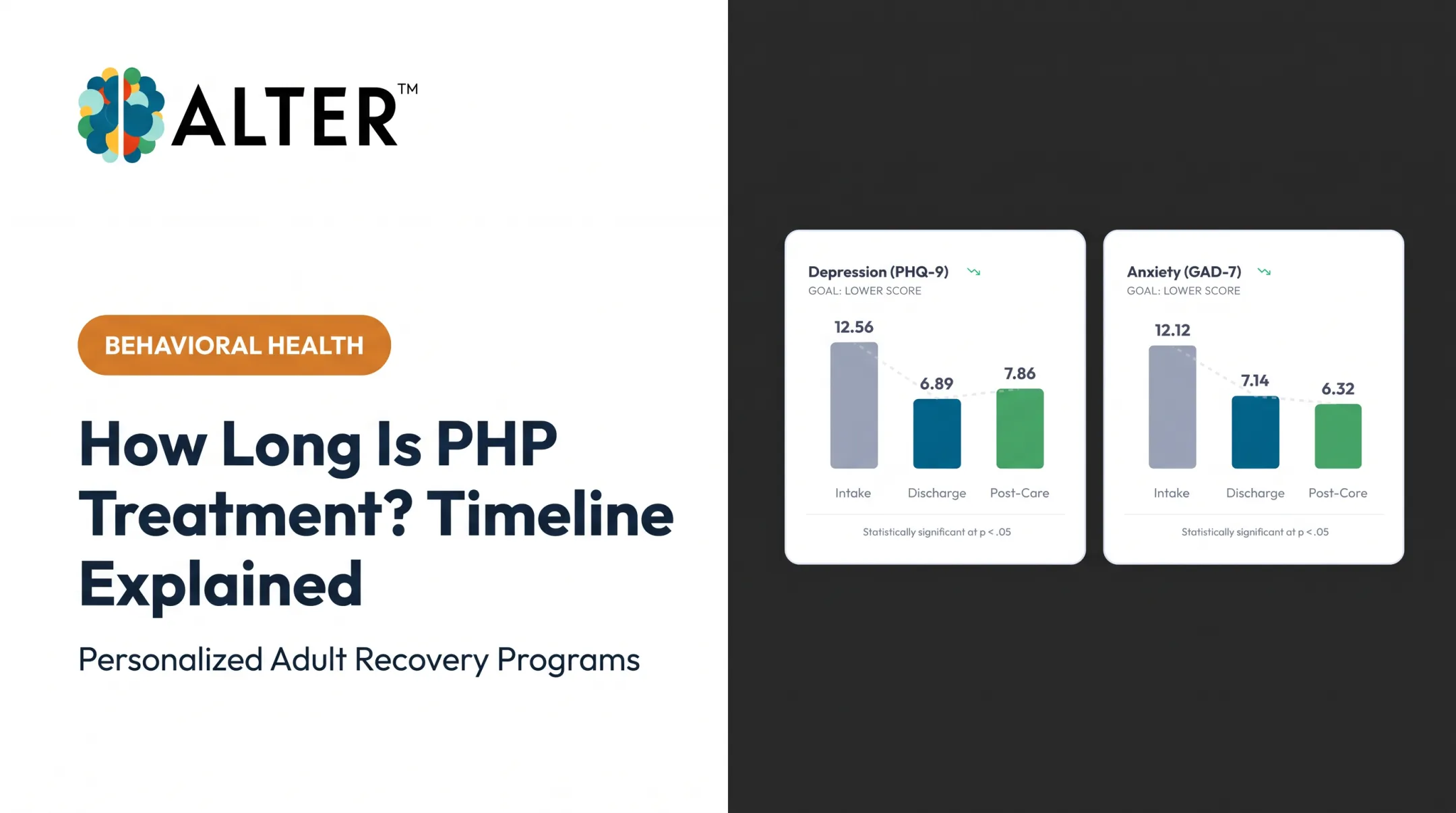
A peer-reviewed study of 205 adults in DBT-informed psychiatric programs documented these same pathways in practice (Mochrie et al., 2020):

- 33 people completed PHP only
- 106 stepped down from PHP into IOP
- 66 entered IOP directly
Across all three pathways, depression, anxiety, and hopelessness improved significantly from admission to discharge. No pathway outperformed the others—there is no single correct route through care.
Before enrolling anywhere, ask about:
- Assessment procedures
- Insurance authorization
- Scheduling
- Family participation
- Aftercare planning
- Crisis protocols
If you're exploring options with Alter Behavioral Health, the admissions team at (866) 248-9285 can walk through these details after you've gathered your questions.
Conclusion
PHP generally means more hours, tighter clinical structure, and closer daily support. IOP generally means a lighter schedule for people who can safely manage life outside treatment hours. Neither is inherently superior.
The right level of care should rest on clinical need, not cost or convenience alone. Weigh factors such as:
- Current symptoms and safety risk
- Daily functioning at home, work, or school
- Living environment and support system
- Co-occurring mental health or substance use conditions
- Insurance coverage and access to care
A professional level-of-care assessment is the only reliable way to know which path fits.
If you're trying to figure out where you or a loved one belongs on that continuum, Alter Behavioral Health offers personalized assessments across its Southern California programs, with admissions support available by phone at (866) 248-9285 or (866) 386-6503.
Frequently Asked Questions
What is the difference between PHP and IOP?
PHP usually runs full treatment days several times a week. IOP offers structured care with more schedule flexibility, often a few hours per session. Exact hours vary by provider.
Which is more intensive, PHP or IOP?
PHP is the more intensive level, with more weekly treatment hours and closer clinical oversight. Program designs still differ, so confirm weekly hours and staffing with each provider.
How does the cost of PHP compare to IOP?
PHP often costs more because it usually involves more treatment hours and staffing. Your actual out-of-pocket cost depends on insurance benefits, deductibles, prior authorization, and the specific provider's fees.
Which comes first, PHP or IOP?
PHP often precedes IOP when someone is stepping down from a more intensive level of care. However, people can enter either program directly based on their clinical needs; there's no fixed sequence everyone follows.
What is the difference between residential treatment and PHP?
Residential treatment means living at the facility with round-the-clock support. PHP provides intensive daytime treatment while you return to a separate living environment, like home or sober living, each evening.
How long do people usually stay in PHP?
Duration varies by symptoms, progress, and insurance authorization. Some programs run around 10 treatment days, while others last several weeks. Ask about review points and transition planning during your assessment.